What is it?
Moisture problems are situations in which water or excess moisture affects the materials of a building in unintended ways. They may be caused by rising damp, leaks and water ingress, condensation, leaking installations or insufficient ventilation.
In Building Biology they are a biological factor of great importance, because they change the conditions of the indoor environment and encourage the deterioration of materials when they persist over time.
Damp is not always obvious. Sometimes it shows up as stains, flaking, characteristic odours or deformed materials; at other times it remains hidden in cavities, false ceilings or behind wall linings.
Where can it be found?
It can appear in basements, ground floors, façades, roofs, bathrooms, kitchens, junctions between building elements, cavities, walls in contact with the ground and any area affected by water ingress or leaks.
It also develops on cold surfaces where condensation forms repeatedly.
Each building has different causes, so identifying the origin is essential before planning any corrective work.
How does it affect the space?
Moisture changes the hygrothermal behaviour of materials and can encourage the appearance of other biological factors, such as moulds, yeasts or bacteria.
It is therefore a cross-cutting condition: it is related to ventilation, temperature, air quality and the other physical, chemical and biological factors. The assessment seeks to understand the origin of the problem and evaluate its consequences for the building, rather than looking only at the visible symptoms.
How is it assessed?
What the inspection looks at
A detailed visual inspection identifies signs of damp and possible routes of water entry.
What is recorded for each measurement
Equipment, quantity, unit, location, date, measurement conditions and duration, together with the relevant limitations and the interpretation criterion applied.
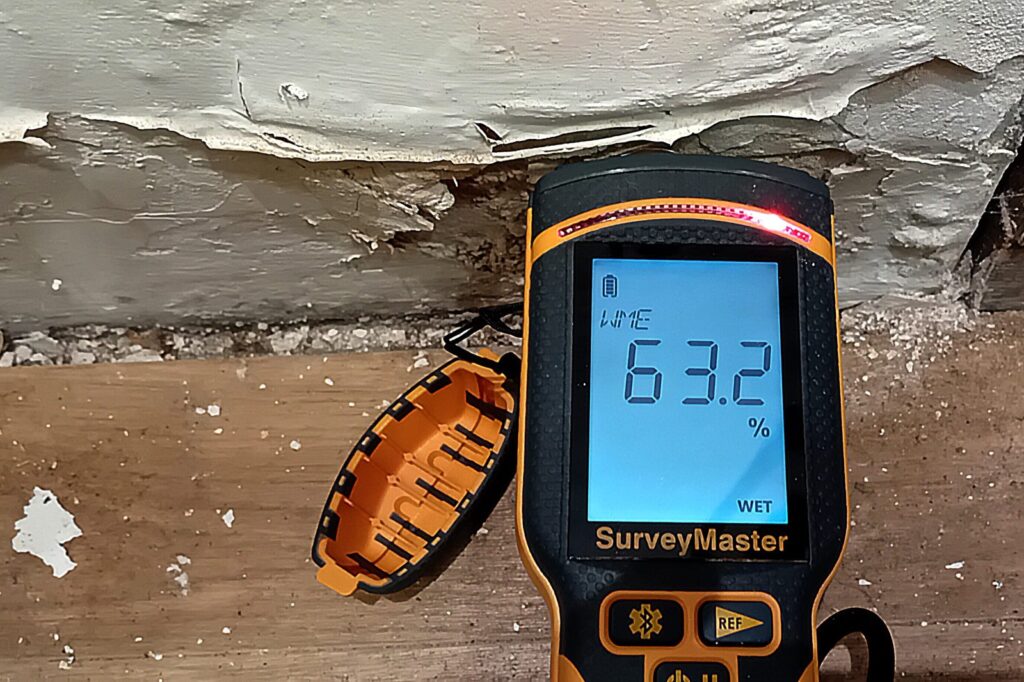
How this factor is measured
Measurements are taken with specialist professional instruments to determine the moisture content of materials, hygrothermal conditions and other related parameters.
Depending on the case, additional inspections may be carried out, and samples taken where there are signs of associated microbiological contamination.
In assessments intended as expert evidence, calibrated instruments are used to ensure the reliability and traceability of the measurements.
Criteria
Interpretation is based on identifying the mechanism causing the moisture, the condition of the materials and the results obtained during the inspection.
The assessment considers the building as a whole and the interaction with the other environmental factors assessed.
This guide does not publish values or thresholds. Technical criteria, legal limits and recommendations are different things and are not presented as equivalent.
Improvement measures
Work always begins by understanding and, where possible, reducing the source, before acting on the path or on the space. Measures are prioritised by expected effect, feasibility and proportionality, and no products are recommended by default.
The action taken always depends on the cause identified. Options that may be considered include:
- Repairing leaks and points of water ingress.
- Treating rising damp.
- Improving ventilation.
- Correcting thermal bridges.
- Drying out affected materials.
- Remediating damaged elements where necessary.
Recommendations are always made after an individual assessment.
How Cemprotecta helps
This factor is not assessed on its own. It is, in fact, a cross-cutting condition: identifying its origin is usually the first step towards understanding other biological factors in the building.
What an assessment gives you is knowing what is there, where it is and what can be done about it, with an ordered sequence of measures rather than a list of problems.
- Inspection of the space and of moisture conditions.
- Sampling when the scope of the assessment requires it.
- Combined interpretation with the other factors assessed.
- A report identifying the possible causes and the applicable measures.
Request an assessment
If this factor concerns you in your home or workplace, tell us about your case. The prior inspection will determine whether it is worth measuring and what else should be assessed alongside it.