Risk factors
Risk factors, one assessment
Cemprotecta groups the environmental factors of a space into three families —physical, chemical and biological— and assesses them as parts of a single system.
The classification organises information; it does not split the assessment into pieces. No family is more important than another by default, and not every factor needs to be measured in every space.
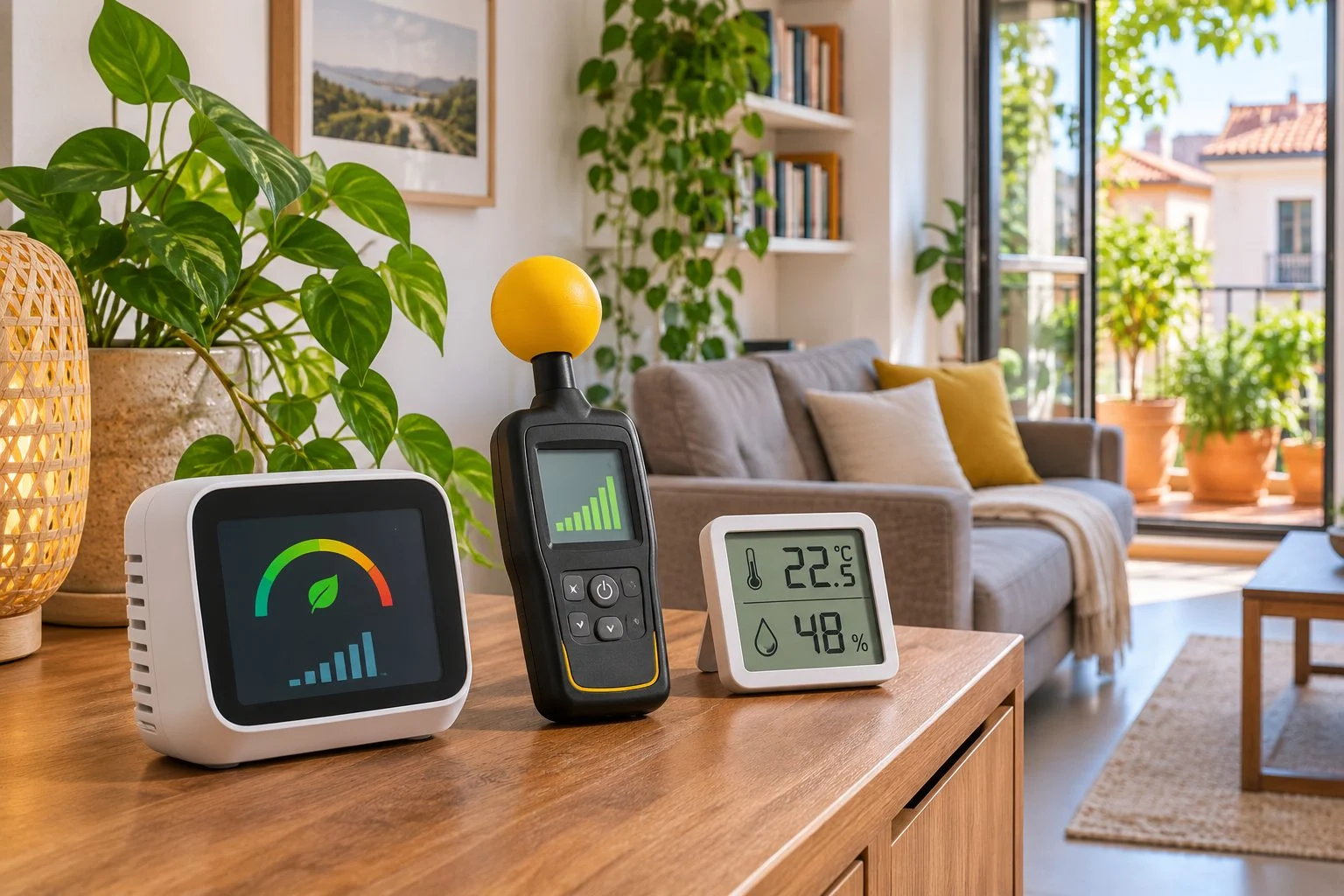
Approach
A single factor on its own rarely explains a situation.
The inspection determines which variables are relevant in each case; measurements provide the data; technical interpretation relates them to one another.
That is why the choice of measurements follows the space and the technical objective, and is justified by the prior inspection. An assessment is not a collection of isolated tests, nor a fixed package that is the same for every case.
Family 01 · ten factors
Physical factors
Measurable phenomena related to electricity, magnetism, signals, location, sound and light.
Fields associated with alternating voltages in installations, wiring and equipment.
/en/risk-factors/physical/ac-electric-fields/
Fields associated with the flow of alternating current: transformers, motors, wiring or distribution boards.
/en/risk-factors/physical/ac-magnetic-fields/
Electromagnetic signals from communications and wireless transmission, indoors and outdoors.
/en/risk-factors/physical/radio-frequency-radiation/
Build-up of static electric charge on people, surfaces or materials.
/en/risk-factors/physical/electrostatics/
Static magnetic fields from magnets, ferromagnetic elements or direct currents.
/en/risk-factors/physical/magnetostatics/
Ionising radiation of natural or artificial origin, within the defined technical scope.
/en/risk-factors/physical/radioactivity/
Possible variations related to the location of the building, assessed with technical caution.
/en/risk-factors/physical/geopathic-stress/
Unwanted sound, or sound unsuited to the use of the space: level, duration, frequency and transmission.
/en/risk-factors/physical/noise/
Mechanical movement transmitted through structures, installations, traffic or machinery.
/en/risk-factors/physical/vibration/
Natural and artificial lighting: levels, distribution, contrast, glare and flicker.
/en/risk-factors/physical/light/
Family 02 · seven factors
Chemical factors
Substances and indoor air conditions arising from materials, products, installations, processes or occupancy.
The state of the air in relation to ventilation, occupancy and the sources present. It does not replace specific measurements.
/en/risk-factors/chemical/indoor-air-quality/
Volatile organic compounds (VOCs)
Substances that can be emitted by materials, products, activities or combustion.
/en/risk-factors/chemical/vocs/
An aldehyde that can come from materials, furniture, adhesives, processes or combustion.
/en/risk-factors/chemical/formaldehyde/
A family distinct from formaldehyde that may require specific analysis.
/en/risk-factors/chemical/other-aldehydes/
Particulate material suspended in the air, classified by size or other criteria.
/en/risk-factors/chemical/particulate-matter/
A gas linked to incomplete combustion. Any suspicion of acute exposure is referred to the competent services.
/en/risk-factors/chemical/carbon-monoxide/
An indicator linked to occupancy and ventilation; on its own it is not equivalent to air quality.
/en/risk-factors/chemical/carbon-dioxide/
Family 03 · five factors
Biological factors
Moisture and the organisms associated with it. Before the consequences are treated, the cause is investigated.
The presence, origin or persistence of moisture in materials and indoor environments. A condition that cuts across all the others.
/en/risk-factors/biological/moisture-problems/
Fungal growth associated with favourable conditions of moisture and substrate.
/en/risk-factors/biological/mould/
Fungal microorganisms that can appear in damp environments or materials.
/en/risk-factors/biological/yeasts/
Microorganisms that can be assessed on surfaces, in the air or in other media, depending on the objective of the assessment.
/en/risk-factors/biological/bacteria/
Organisms associated with dust, textiles and the environmental conditions of the space.
/en/risk-factors/biological/dust-mites/
Further reading
Guide to environmental factors
Each factor has its own guide with the same structure: what it is, where it can be found, how it affects the space, how it is assessed, which criteria apply, what improvement measures exist and how Cemprotecta helps.
All the guides share the same structure. That makes them easy to compare and means you always know where to find each thing.
Also considered
What else an assessment covers
Not everything observed in a space has its own guide. Some variables are interpreted as part of another factor, because on their own they say little; others fall outside these assessments. It is worth knowing this before commissioning an assessment.
- Temperature and relative humidity. Always recorded as context: they affect air quality, comfort and how damp behaves.
- Ventilation. Observed as a condition of the building, because it explains much of what is measured in the indoor air.
- Radon. Assessed as part of Radioactivity.
- Electromagnetic pollution. Not used as a category: the specific, measurable categories are assessed instead —electric fields, magnetic fields and radio-frequency radiation—, each with its own guide.
- Water quality. Not part of these assessments.
- Pollen, pet dander and other allergens. Not assessed as factors in their own right.
- Asbestos, lead or pesticides. Not part of the standard assessment.
If any of these parameters is relevant in your case, let us know: any of them can be used as a supporting indicator or included in an assessment when the case justifies it.
Criteria
How we decide what to measure
The choice of measurements is justified by the objective of the assessment, the prior inspection, the type of space and the sources identified. Not every factor has to be measured on every visit.
- The equipment, quantity, unit, location and conditions of each measurement are recorded.
- A distinction is made between direct measurement, logging, sampling and laboratory analysis.
- Technical criteria, legal limits and recommendations are never mixed.
- Conclusions avoid absolute statements when a measurement is a one-off.
Not sure which factor affects you?
You don’t need to know. Tell us what is happening in your space and the inspection will determine what should be assessed.