What is it?
Mould is a group of filamentous fungi capable of growing on the materials of a building when favourable conditions of moisture, temperature and available nutrients coincide. It is not a surface stain, but growth that colonises the material and advances for as long as those conditions persist.
Indoors, it is one of the main biological factors assessed in healthy building assessments. Its presence is usually associated with persistent moisture problems, so it rarely explains itself: it almost always points to a condition in the building that has been acting for some time.
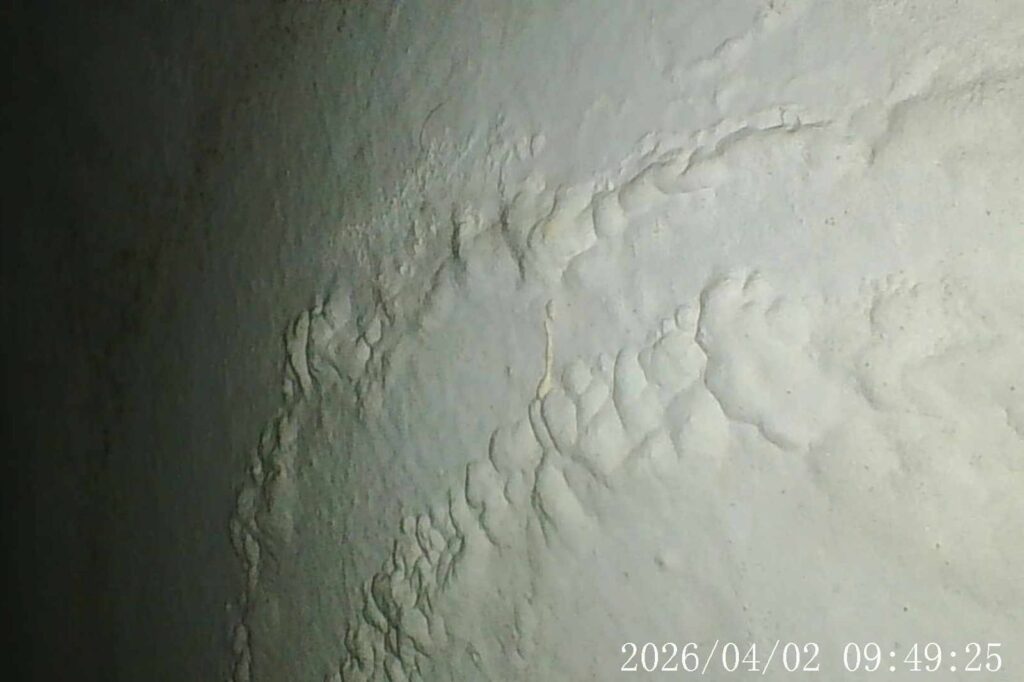
It is not always visible: it can develop in cavities, behind wall linings, in false ceilings, voids or heating and air-conditioning systems. It affects organic materials such as wood, plaster, cardboard, paint, textiles, accumulated dust and other building elements, and causes progressive deterioration unless the underlying cause is removed.
Where can it be found?
It is commonly found in areas affected by condensation, water ingress, rising damp or leaking installations. Also in bathrooms, kitchens, basements, underfloor voids, behind furniture placed against cold walls, around windows, in false ceilings and in air-conditioning ducts.
In many cases the growth remains hidden, so a visual inspection is not always enough to rule it out. Identifying the source of the moisture is essential to understanding the problem.
How does it affect the space?
Mould affects a building locally: some areas are affected and others are not, and what separates them are the conditions that favour its growth —moisture, temperature and the availability of nutrients in the material.
Nor is its spread static. If the cause persists, the deterioration of organic materials progresses, so the extent of the problem depends on how long the condition that allows it has been present.
How is it assessed?
What the inspection looks at
A detailed technical inspection locates visible and hidden signs of moisture and fungal growth.
What is recorded for each measurement
Equipment, quantity, unit, location, date, measurement conditions and duration, together with the relevant limitations and the interpretation criterion applied.
How this factor is measured
Moisture measurements in materials, additional inspections and, where the assessment requires it, sampling of surfaces, dust or air using specific methodologies may be carried out.
Interpretation takes into account the condition of the building, the source of the moisture and the information obtained during the inspection.
In assessments intended as expert evidence, calibrated instruments and appropriate sampling protocols are used to ensure the reliability and traceability of the results.
Criteria
The assessment brings together the visual inspection, moisture measurements, laboratory results where available and the analysis of the building as a whole.
Interpretation seeks to identify the origin of the problem before planning any corrective or remediation work.
This guide does not publish values or thresholds. Technical criteria, legal limits and recommendations are different things and are not presented as equivalent.
Improvement measures
Work always begins by understanding and, where possible, reducing the source, before acting on the path or on the space. Measures are prioritised by expected effect, feasibility and proportionality, and no products are recommended by default.
The action taken always depends on the cause that favours the growth. Options that may be considered include:
- Eliminating the source of the moisture.
- Drying out materials.
- Replacing elements that cannot be recovered.
- Applying a specific remediation plan where necessary.
Recommendations are adapted to the characteristics of the building and the extent of the contamination detected.
How Cemprotecta helps
This factor is not assessed on its own. It is studied together with the moisture conditions that allow it, because treating mould without correcting its cause does not solve the problem.
What an assessment gives you is knowing what is there, where it is and what can be done about it, with an ordered sequence of measures rather than a list of problems.
- Inspection of the space and of moisture conditions.
- Sampling when the scope of the assessment requires it.
- Combined interpretation with the other factors assessed.
- A report identifying the possible causes and the applicable measures.
Request an assessment
If this factor concerns you in your home or workplace, tell us about your case. The prior inspection will determine whether it is worth measuring and what else should be assessed alongside it.