What is it?
Volatile organic compounds (VOCs) are a broad group of chemical substances that evaporate easily at room temperature and pass into the indoor air.
They are not a single substance but a family of compounds with different properties and behaviour. They are found in many everyday products and building materials, and are among the main chemical factors assessed in indoor air quality studies.
Their presence depends on the emission sources, ventilation, temperature, humidity and the time elapsed since the materials were installed or used.
Where can it be found?
The most common sources include paints, varnishes, adhesives, sealants, solvents, furniture, wood-based panels, wall and floor coverings, cleaning products, air fresheners, cosmetics, plastic materials and certain activities carried out indoors.
They can also come from outside, particularly in areas with heavy traffic or industrial activity, entering the building through ventilation.
How is it assessed?
What the inspection looks at
The technical inspection identifies potentially emitting materials and activities.
What is recorded for each measurement
Equipment, quantity, unit, location, date, measurement conditions and duration, together with the relevant limitations and the interpretation criterion applied.
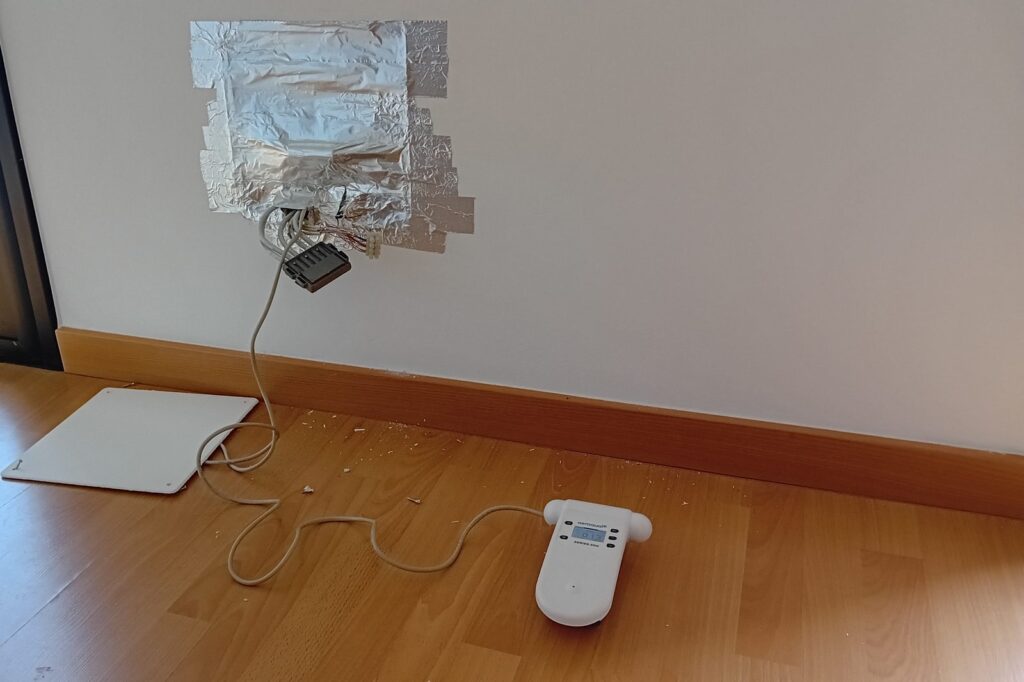
How this factor is measured
Depending on the scope of the assessment, measurements are taken with professional instruments or specific samples are collected for subsequent analysis.
Interpretation takes into account the context of the building, the existing ventilation and the nature of the sources detected.
In assessments intended as expert evidence, calibrated instruments are used to ensure the reliability and traceability of the measurements.
Criteria
Interpretation uses recognised technical references for indoor air quality and guidance values applicable to the type of compound assessed.
The assessment takes into account the intended use of the building, how long occupants spend there and the full set of environmental parameters analysed.
This guide does not publish values or thresholds. Technical criteria, legal limits and recommendations are different things and are not presented as equivalent.
Improvement measures
Work always begins by understanding and, where possible, reducing the source, before acting on the path or on the space. Measures are prioritised by expected effect, feasibility and proportionality, and no products are recommended by default.
The action taken depends on the origin of the emissions. Options that may be examined include:
- Improving ventilation.
- Replacing high-emission materials.
- Choosing low-emission products.
- Controlling the sources identified.
- Reviewing certain processes or usage habits.
Recommendations are always adapted to the characteristics of the building and the results obtained.
How Cemprotecta helps
This factor is not assessed on its own. It is measured within an assessment that treats the space as a system, because its presence depends on the materials, the use of the building and how it is ventilated.
What an assessment gives you is knowing what is there, where it is and what can be done about it, with an ordered sequence of measures rather than a list of problems.
- Inspection of the space and of accessible installations.
- Measurement or sampling in the rooms where people spend most time.
- Combined interpretation with the other factors assessed.
- A report with measures ranked by their expected effect on exposure.
Request an assessment
If this factor concerns you in your home or workplace, tell us about your case. The prior inspection will determine whether it is worth measuring and what else should be assessed alongside it.