What is it?
DC electric fields, or electrostatic fields, are produced by the build-up of electric charges on the surface of materials and objects.
Unlike AC electric fields, they are not associated with the mains frequency but with static electricity phenomena caused by friction, contact between materials or certain environmental conditions.
The SBM-2024 includes their assessment among the physical factors of the indoor environment. Charge build-up depends on the type of materials present, the relative humidity of the air, the everyday use of the spaces and the characteristics of the building finishes.
Where can it be found?
Static electricity can occur on carpets, synthetic flooring, textiles, furniture, plastics, screens, electronic equipment and other materials capable of holding a charge. Dry conditions and certain heating and air-conditioning systems help it persist.
In office buildings, chairs on castors, synthetic coverings and the continuous use of computer equipment also play a part. In homes, particular attention is usually paid to bedrooms and areas where people spend long periods.
How is it assessed?
What the inspection looks at
The technical inspection identifies the materials present and the environmental conditions of the space.
What is recorded for each measurement
Equipment, quantity, unit, location, date, measurement conditions and duration, together with the relevant limitations and the interpretation criterion applied.
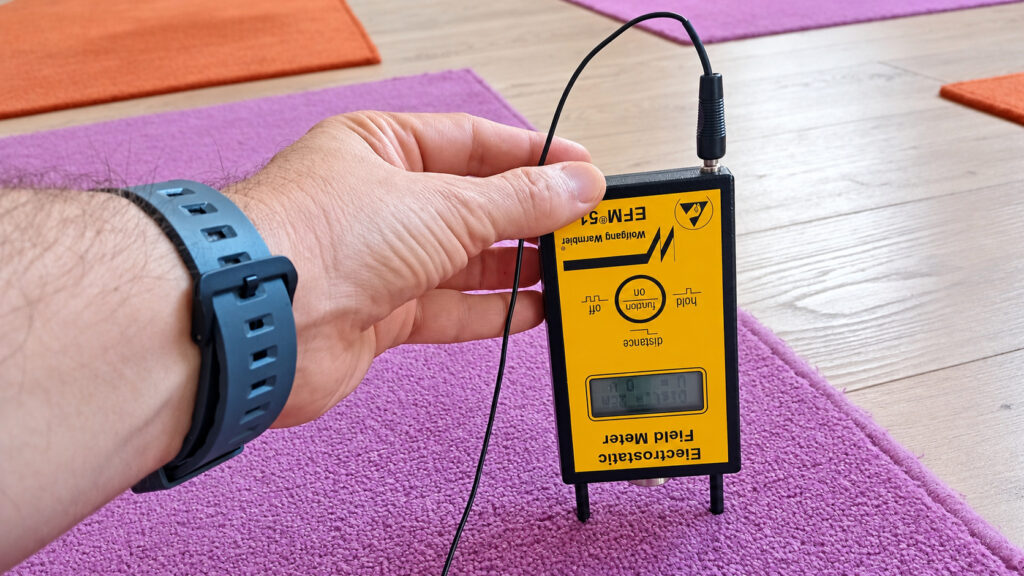
How this factor is measured
Measurements are taken with specialist professional instruments to determine whether DC electric fields are present and to evaluate the electrostatic behaviour of the different surfaces.
Ambient humidity, the earthing of certain elements and the influence of the materials used in finishes and coverings can also be analysed.
In assessments intended as expert evidence, calibrated instruments are used to ensure the reliability and traceability of the measurements.
Criteria
Interpretation follows the SBM-2024, taking into account the guidance values set for indoor spaces and the particular conditions of the building.
The evaluation takes into account the intended use of the room, the location of the charge sources and the interaction with the other environmental factors assessed.
This guide does not publish values or thresholds. Technical criteria, legal limits and recommendations are different things and are not presented as equivalent.
Improvement measures
Work always begins by understanding and, where possible, reducing the source, before acting on the path or on the space. Measures are prioritised by expected effect, feasibility and proportionality, and no products are recommended by default.
The action taken depends on the origin of the static electricity detected. Options that may be considered include:
- Using materials that are less prone to becoming charged.
- Controlling ambient humidity.
- Improving the earthing of certain elements.
- Rearranging the furniture.
- Replacing finishes where technically advisable.
Each recommendation is adapted to the characteristics of the building and to the results obtained, avoiding generic solutions that do not meet the real needs of the space.
How Cemprotecta helps
This factor is not assessed on its own. It is measured as part of an assessment that treats the space as a system, because it depends both on the building’s materials and on the environmental conditions in each room.
What an assessment gives you is knowing what is there, where it is and what can be done about it, with an ordered sequence of measures rather than a list of problems.
- Inspection of the space and of accessible installations.
- Measurement in the rooms where people spend most time.
- Combined interpretation with the other factors assessed.
- A report with measures ranked by their expected effect on exposure.
Request an assessment
If this factor concerns you in your home or workplace, tell us about your case. The prior inspection will determine whether it is worth measuring and what else should be assessed alongside it.